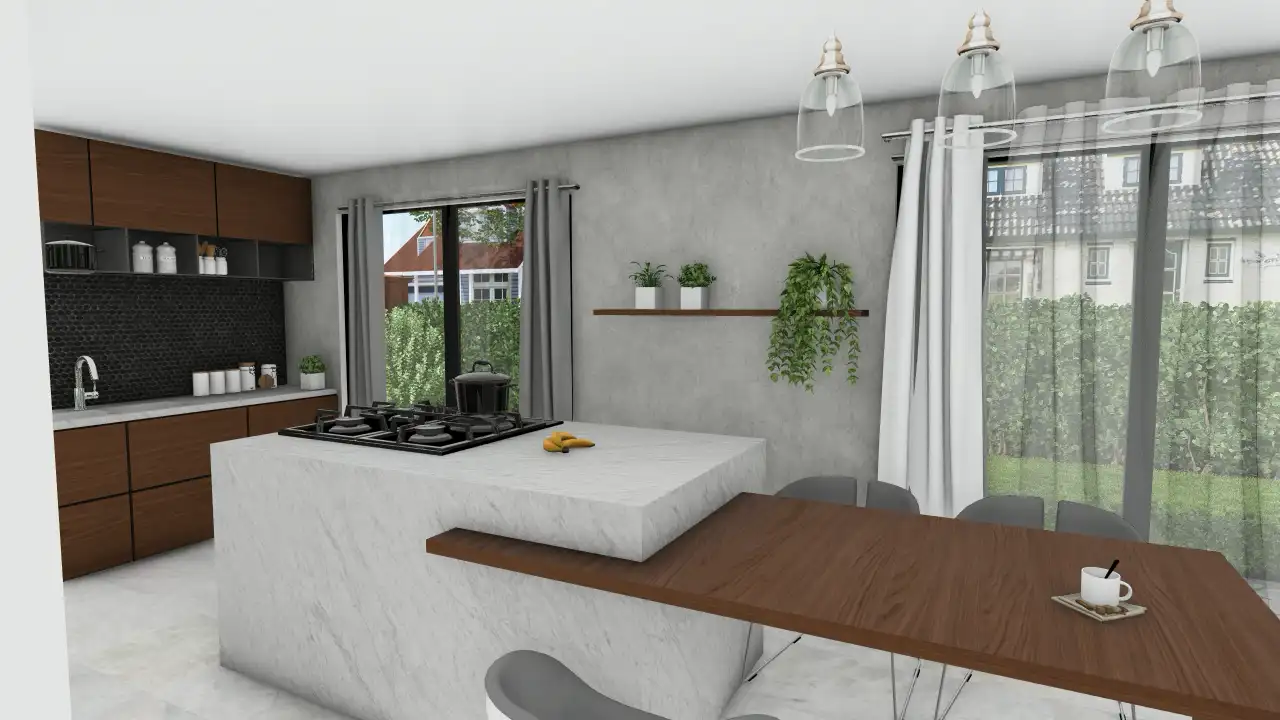
Costing specifics for CFC 273: Interior joinery
CFC 273 encompasses the fabrication and installation of interior doors, built-in cupboards, made-to-measure fittings and timber staircases, as well as skirting boards and wall claddings. Reference collective agreement in the Studio: CCT-SOR (collective agreement for the finishing trades of French-speaking Switzerland). The Studio’s default measurement unit is pc; the figures below are those of the Studio’s latest update, with Vaud as the starting canton.
In CFC 273, pricing is based on the piece for door sets, frames or fitted furniture. The linear metre commonly applies to skirting boards, handrails and scribing fillets, while the square metre is used for wall claddings, timber suspended ceilings and decorative panels. Complex work or prototypes are often priced as a lump sum. Special ironmongery, ventilation grilles or cut-outs for integrating other trades are counted separately. To limit discrepancies in the final account, state clearly in your offer the limits of supply and the method of taking measurements.
| Item | Value in the Studio |
|---|---|
| CFC code | 273 |
| Title | Interior joinery |
| Reference collective agreement | CCT-SOR (collective agreement for the finishing trades of French-speaking Switzerland) |
| Default measurement unit | pc |
| VAT applied | 8.1% |
Items often forgotten in a quote for interior joinery
- Final site measurement after completion of the screeds and the plastering
- Specific adjustments around the passages of service pipes or built-in electrical sockets
- Careful protection of the finished joinery until acceptance of the work by the client
- Delicate handling up the stairs when no lift is in service
- Supply and installation of acoustic or fire-rated seals not included in the basic details
Neighbouring trades
A building site involves several trades in succession, and each line of a quote carries its own CFC code: you can therefore combine several trades in a single document. Here are the other Studio codes attached to the same cost profile, with their default unit.
| CFC | Title | Default unit | Page |
|---|---|---|---|
| 213 | Structural steelwork | kg | Quote CFC 213 |
| 214 | Carpentry & timber structures | m² | Quote CFC 214 |
| 221 | Joinery & windows | pc | Quote CFC 221 |
| 222 | Sheet-metal work | m² | Quote CFC 222 |
| 224 | Roofing & waterproofing | m² | Quote CFC 224 |
| 226 | Rendering & façade insulation | m² | Quote CFC 226 |
| 228 | Shutters & blinds | pc | Quote CFC 228 |
| 271 | Plastering & drywall | m² | Quote CFC 271 |
| 272 | Metal construction & locksmith work | pc | Quote CFC 272 |
| 281 | Floor coverings (tiling, parquet) | m² | Quote CFC 281 |
| 282 | Wall coverings & wall tiling | m² | Quote CFC 282 |
| 285 | Painting & wallpapering | m² | Quote CFC 285 |
| 287 | Final site cleaning | m² | Quote CFC 287 |
SIA 118 clauses, retention and SUVA safety
SIA standard 118 governs the contractual relationship between the joiner and the client when it is declared applicable in the agreement. It specifies the formal arrangements for acceptance of the work, with the drawing-up of a record. From acceptance, the two-year defects notification period begins to run for the reporting of defects under the notice-of-defects procedure. It also governs settlement according to actual measurement, offering a secure framework for closing the site financially.
SIA 118 as contractual basis
Tick box (unticked by default).
SIA standard 118 “General Conditions for Construction Work” forms part of the contract, in addition to the Swiss Code of Obligations.
Asbestos and pollutants
Ticked by default.
Reservation in the event of asbestos or other pollutants not detected before the work (OTConst).
Rise in material prices
Ticked by default.
Reservation for increases in material prices according to the KBOB indices in force.
Pricing method
Your choice, when printing.
Unit prices, settlement according to actual measurement (Art. 374 CO) — or fixed lump-sum price (Art. 373 CO).
Retention
On joinery sites, site management often withholds a financial share from each monthly interim payment to cover any defects in execution. Our tool lets you adjust this retention from 0 to 10%. When the final account is drawn up, this blocked amount may be released or replaced by an equivalent bank or insurance guarantee, according to the special clauses of your contract. In the Studio’s copilot, the retention (SIA 118) can be set to 0, 5 or 10% of the total incl. VAT, with 10% as the default; cash discount and retention reduce what you actually collect, whereas the discount and the pro-rata account reduce the quote itself.
Safety: what SUVA accident insurance costs
Occupational accident insurance (SUVA) is paid entirely by the employer: 3.5% of gross pay for the Finishing trades CCT-SOR profile in the Studio. For an employee earning CHF 6'050 a month, that is CHF 211.75 a month at your expense, before a single hour has been worked. This premium is part of the 25% of charges that the Studio builds into your daywork rate.
Daywork and profitability: the real cost of one hour of interior joinery
The most common trap: invoicing on the basis of the hourly wage. An employee with the “Experienced qualified tradesperson (class A)” profile earns CHF 6'050 a month, i.e. CHF 34.38 over 176 paid hours. Once charges of 25.8% (Vaud) and CHF 595 of monthly expenses (meals, travel, equipment) are added, and the result is divided by the 135 genuinely productive hours, one hour costs CHF 60.78, before overheads and margin. You pay for every hour, but you invoice only part of them.
| Step | Hours |
|---|---|
| Paid hours (176 h × 12 months) | 2'112 |
| Holidays (25 days) | −212 |
| Public holidays (9 days) | −76 |
| Sickness / accident absences (average) | −68 |
| Depot preparation, loading, travel and bad weather | −136 |
| Productive hours used by the Studio | 1'620 |
How to read this table. Start from the 2'112 paid hours and take away holidays, public holidays, absences and time spent at the depot, loading and travelling: 1'620 billable hours remain, i.e. 77% of paid time.
When to invoice on a daywork basis
Interventions that cannot be priced in advance, such as the careful removal of old frames, remedial work after other trades or touch-ups following changes to the drawings, are handled as daywork. Have your daywork sheets signed daily or weekly by site management to certify the hours worked. Additional equipment, specific ironmongery and travel costs are generally invoiced on top, according to the contractual agreements.
| Profile | Average gross monthly pay | Daywork rate |
|---|---|---|
| Finishing trades foreman (CCT-SOR) | 6'750 CHF | 106.00 |
| Experienced qualified tradesperson (class A) | 6'050 CHF | 96.00 |
| Recently qualified tradesperson (1st to 3rd year after diploma) | 5'500 CHF | 88.00 |
| Skilled worker / federal certificate holder (class B) | 5'300 CHF | 85.00 |
| Finishing trades assistant (class C) | 4'850 CHF | 79.00 |
How to read this table. Vaud is the reference canton (coefficient 0%). Gross monthly pay is the average wage for the profile; the daywork rate is the hourly rate to invoice, excluding VAT. In another canton, the daywork rate is multiplied by the regional coefficient: the “Experienced qualified tradesperson (class A)” profile goes from CHF 96.00/h in Vaud to CHF 107.50/h in Geneva (+12%). See the page for the canton of Geneva.
Frequently asked questions about quotes for interior joinery (CFC 273)
How can the installation time be estimated for a made-to-measure interior joinery package?
Installation time varies according to the accessibility of the rooms, the plumb of the walls and the degree of finish achieved in the workshop. For made-to-measure fittings, allow an hours ratio that takes account of unloading, the scribing of the filler strips and the fine adjustment of the ironmongery. It is useful to find out about the progress of the screeds and the painting, to avoid unproductive return trips that can penalise your profitability.
What should be done when the actual site dimensions differ from the architect’s drawings?
As soon as the dimensions are surveyed, if major deviations appear compared with the working drawings supplied, report them immediately in writing to site management before launching fabrication. This formal step makes it possible to clarify the adaptations required, to approve any extras for the modification of standard elements and to adjust the installation schedule in agreement with the client.
How should the disposal of packaging and timber offcuts be dealt with in the quote?
The removal and sorting of protective packaging, cardboard, pallets and panel offcuts must be covered by a separate item or be clearly included in your overheads. If the site does not provide shared skips, count the loading time, the transport and the municipal or cantonal waste-disposal charges linked to treated materials.
Who is responsible for protecting the joinery elements after they have been installed?
By default, the joiner protects the work immediately after installation. However, the upkeep of this protection during the later interventions of painters or parquet layers must be defined in the contract. State in your quote that your responsibility ends on delivery of the protected elements and that the upkeep of this protection then lies with site management.
From quote to site
Studio Devis Suisse is free and is enough for a one-off quote. When your quotes multiply, two tools take over where the Studio stops: the full price list to cost faster, then site tracking to check the real margin, hour after hour.
The same trade in the 26 cantons
The regional coefficient, the charges and the family allowances change from one canton to another: open the page for the canton of your site to see the daywork rate and the charges that apply there.
- Vaud (VD)
- Geneva (GE)
- Valais (VS)
- Fribourg (FR)
- Neuchâtel (NE)
- Jura (JU)
- Bern (BE)
- Zurich (ZH)
- Zug (ZG)
- Basel-Stadt (BS)
- Basel-Landschaft (BL)
- Aargau (AG)
- Solothurn (SO)
- Lucerne (LU)
- Schwyz (SZ)
- Nidwalden (NW)
- Obwalden (OW)
- Uri (UR)
- St. Gallen (SG)
- Thurgau (TG)
- Schaffhausen (SH)
- Appenzell Ausserrhoden (AR)
- Appenzell Innerrhoden (AI)
- Glarus (GL)
- Graubünden (GR)
- Ticino (TI)