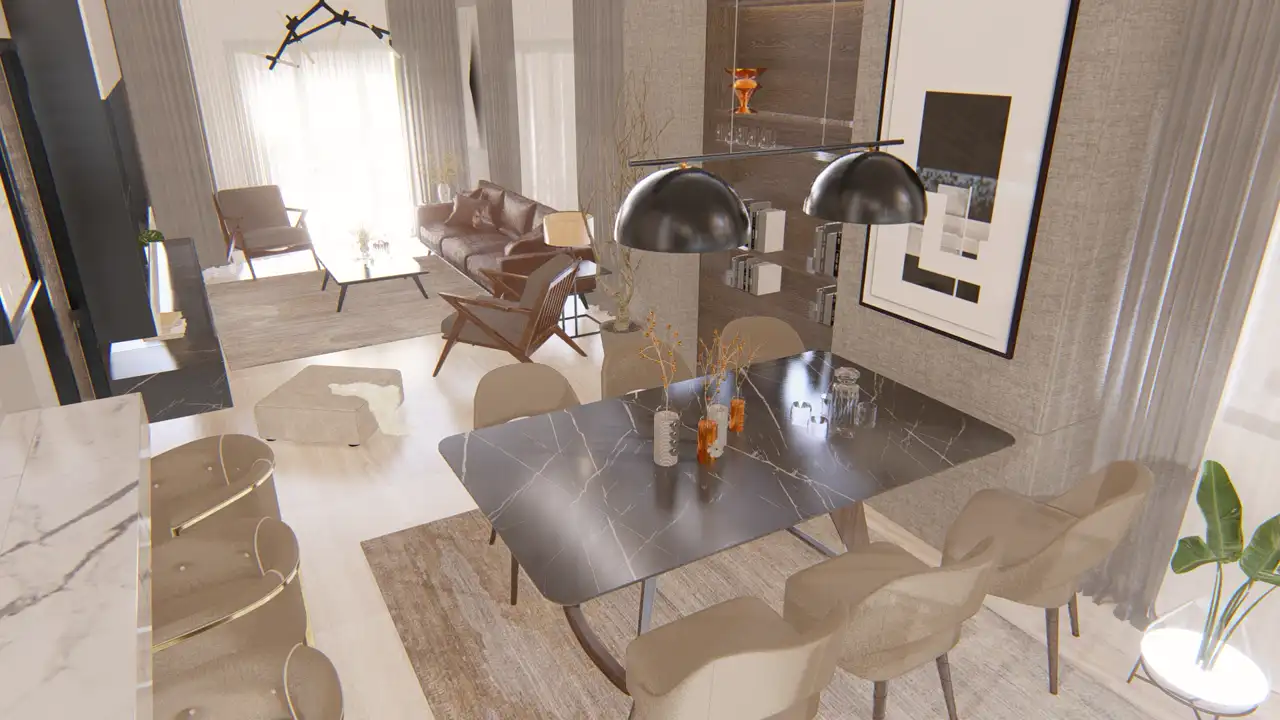
Costing specifics for CFC 287: Final site cleaning
CFC 287 covers the rough cleaning and then the fine cleaning of buildings, the washing of glazing and frames and the removal of residues before the formal handover of the work. The Studio prices this trade with the finishing-trades profile, as an indicative and editable basis: check the collective agreement of your sector. The Studio’s default measurement unit is m²; the figures below are those of the Studio’s latest update, with Vaud as the starting canton.
Measurement is based mainly on the m² of floor area treated for sweeping, vacuuming and washing the floors. Glazing, frames, shutters and blinds are generally assessed by the developed m² or by the piece in accordance with the CAN standard item catalogue (NPK). Skirting boards or handrails are counted by the linear metre. Specific services, such as the removal of unforeseen rubble or the treatment of sensitive floors, are often covered by a lump sum. To avoid disputes over the final account, define precisely the initial condition of the surfaces and the actual areas to be worked on, right from the offer.
| Item | Value in the Studio |
|---|---|
| CFC code | 287 |
| Title | Final site cleaning |
| Reference collective agreement | Studio finishing-trades profile (indicative) |
| Default measurement unit | m² |
| VAT applied | 8.1% |
Items often forgotten in a quote for final site cleaning
- Removal of residues of adhesive tape, delivery labels and glue from the windows
- Meticulous dusting of service ducts, suspended ceilings and the tops of built-in cupboards
- Treatment of stubborn traces of cement, laitance or resin on tiling
- Provision of closed containers for the final removal of the waste collected
- The cost of cherry pickers or mobile scaffold towers for large inaccessible glazed openings
Neighbouring trades
A building site involves several trades in succession, and each line of a quote carries its own CFC code: you can therefore combine several trades in a single document. Here are the other Studio codes attached to the same cost profile, with their default unit.
| CFC | Title | Default unit | Page |
|---|---|---|---|
| 213 | Structural steelwork | kg | Quote CFC 213 |
| 214 | Carpentry & timber structures | m² | Quote CFC 214 |
| 221 | Joinery & windows | pc | Quote CFC 221 |
| 222 | Sheet-metal work | m² | Quote CFC 222 |
| 224 | Roofing & waterproofing | m² | Quote CFC 224 |
| 226 | Rendering & façade insulation | m² | Quote CFC 226 |
| 228 | Shutters & blinds | pc | Quote CFC 228 |
| 271 | Plastering & drywall | m² | Quote CFC 271 |
| 272 | Metal construction & locksmith work | pc | Quote CFC 272 |
| 273 | Interior joinery | pc | Quote CFC 273 |
| 281 | Floor coverings (tiling, parquet) | m² | Quote CFC 281 |
| 282 | Wall coverings & wall tiling | m² | Quote CFC 282 |
| 285 | Painting & wallpapering | m² | Quote CFC 285 |
SIA 118 clauses, retention and SUVA safety
SIA standard 118 governs the arrangements for the joint acceptance of the cleaned surfaces and the immediate issuing of notices of defects. It structures settlement by measurement according to the actual areas and provides a two-year defects notification period for any contractual non-conformities. This contractual balance reassures the client while protecting the contractor against unreasonable demands. Remember, however, that SIA standard 118 applies only if your contract mentions it explicitly.
SIA 118 as contractual basis
Tick box (unticked by default).
SIA standard 118 “General Conditions for Construction Work” forms part of the contract, in addition to the Swiss Code of Obligations.
Asbestos and pollutants
Ticked by default.
Reservation in the event of asbestos or other pollutants not detected before the work (OTConst).
Rise in material prices
Ticked by default.
Reservation for increases in material prices according to the KBOB indices in force.
Pricing method
Your choice, when printing.
Unit prices, settlement according to actual measurement (Art. 374 CO) — or fixed lump-sum price (Art. 373 CO).
Retention
Depending on the contract, the client may provide for a retention on each interim payment and on the final account. Studio Devis Suisse lets you adjust this rate from 0 to 10%. To preserve your cash flow, the sum withheld can often be released or replaced by an equivalent bank or insurance guarantee, returned at the term agreed between the parties once the remarks have been finally cleared. In the Studio’s copilot, the retention (SIA 118) can be set to 0, 5 or 10% of the total incl. VAT, with 10% as the default; cash discount and retention reduce what you actually collect, whereas the discount and the pro-rata account reduce the quote itself.
Safety: what SUVA accident insurance costs
Occupational accident insurance (SUVA) is paid entirely by the employer: 3.5% of gross pay for the Finishing trades CCT-SOR profile in the Studio. For an employee earning CHF 6'050 a month, that is CHF 211.75 a month at your expense, before a single hour has been worked. This premium is part of the 25% of charges that the Studio builds into your daywork rate.
Daywork and profitability: the real cost of one hour of final site cleaning
The most common trap: invoicing on the basis of the hourly wage. An employee with the “Experienced qualified tradesperson (class A)” profile earns CHF 6'050 a month, i.e. CHF 34.38 over 176 paid hours. Once charges of 25.8% (Vaud) and CHF 595 of monthly expenses (meals, travel, equipment) are added, and the result is divided by the 135 genuinely productive hours, one hour costs CHF 60.78, before overheads and margin. You pay for every hour, but you invoice only part of them.
| Step | Hours |
|---|---|
| Paid hours (176 h × 12 months) | 2'112 |
| Holidays (25 days) | −212 |
| Public holidays (9 days) | −76 |
| Sickness / accident absences (average) | −68 |
| Depot preparation, loading, travel and bad weather | −136 |
| Productive hours used by the Studio | 1'620 |
How to read this table. Start from the 2'112 paid hours and take away holidays, public holidays, absences and time spent at the depot, loading and travelling: 1'620 billable hours remain, i.e. 77% of paid time.
When to invoice on a daywork basis
Daywork is often suitable for unforeseen intermediate cleaning, the removal of heavy soiling caused by third parties or occasional touch-ups before acceptance. It is useful to draw up daywork sheets detailing the hours worked and to have them endorsed promptly by site management. Depending on the contract, you invoice in addition the specific machines, the special chemical products, the disposal of waste and the associated travel costs.
| Profile | Average gross monthly pay | Daywork rate |
|---|---|---|
| Finishing trades foreman (CCT-SOR) | 6'750 CHF | 106.00 |
| Experienced qualified tradesperson (class A) | 6'050 CHF | 96.00 |
| Recently qualified tradesperson (1st to 3rd year after diploma) | 5'500 CHF | 88.00 |
| Skilled worker / federal certificate holder (class B) | 5'300 CHF | 85.00 |
| Finishing trades assistant (class C) | 4'850 CHF | 79.00 |
How to read this table. Vaud is the reference canton (coefficient 0%). Gross monthly pay is the average wage for the profile; the daywork rate is the hourly rate to invoice, excluding VAT. In another canton, the daywork rate is multiplied by the regional coefficient: the “Experienced qualified tradesperson (class A)” profile goes from CHF 96.00/h in Vaud to CHF 107.50/h in Geneva (+12%). See the page for the canton of Geneva.
Frequently asked questions about quotes for final site cleaning (CFC 287)
Which contractual distinction should be drawn between site cleaning and final site cleaning under CFC 287?
Intermediate site cleaning aims to keep the workplace usable for the trades, whereas CFC 287 prepares for acceptance by the client. Fine cleaning requires a very careful level of hygienic and aesthetic cleanliness, including the removal of cement film, the dusting of the technical installations and streak-free clear glazing, which calls for specific pricing.
How should the cleaning of complex or high-level glazing be priced?
For glazed surfaces that are difficult to reach, determine the measurement by developing both faces and count the frames, shutters or slatted blinds separately. Provide in your quote for auxiliary equipment such as lifting platforms, cherry pickers or mobile scaffold towers. State whether the supply of demineralised water and the setting-up of safety perimeters on the ground are included or invoiced as an extra.
Which collective labour agreement must be applied to cleaning staff?
In Studio Devis Suisse, a finishing-trades profile is proposed by default to make your calculation easier. However, you should check the sector agreement or the cantonal agreements applicable to your cleaning company with the local joint committees. Pay, travel allowances and job classifications are best made to follow the specific rules applicable in the canton where the work is carried out.
What should be done if the premises are not completely cleared on the date set?
If the site is still cluttered with the materials of other trades when you arrive, report it immediately in writing to site management. A prior joint inspection prevents the residual soiling from being attributed to you. You can then agree on a postponement, on phasing by zones or on additional payment for the successive visits needed to complete the final cleaning.
From quote to site
Studio Devis Suisse is free and is enough for a one-off quote. When your quotes multiply, two tools take over where the Studio stops: the full price list to cost faster, then site tracking to check the real margin, hour after hour.
The same trade in the 26 cantons
The regional coefficient, the charges and the family allowances change from one canton to another: open the page for the canton of your site to see the daywork rate and the charges that apply there.
- Vaud (VD)
- Geneva (GE)
- Valais (VS)
- Fribourg (FR)
- Neuchâtel (NE)
- Jura (JU)
- Bern (BE)
- Zurich (ZH)
- Zug (ZG)
- Basel-Stadt (BS)
- Basel-Landschaft (BL)
- Aargau (AG)
- Solothurn (SO)
- Lucerne (LU)
- Schwyz (SZ)
- Nidwalden (NW)
- Obwalden (OW)
- Uri (UR)
- St. Gallen (SG)
- Thurgau (TG)
- Schaffhausen (SH)
- Appenzell Ausserrhoden (AR)
- Appenzell Innerrhoden (AI)
- Glarus (GL)
- Graubünden (GR)
- Ticino (TI)